
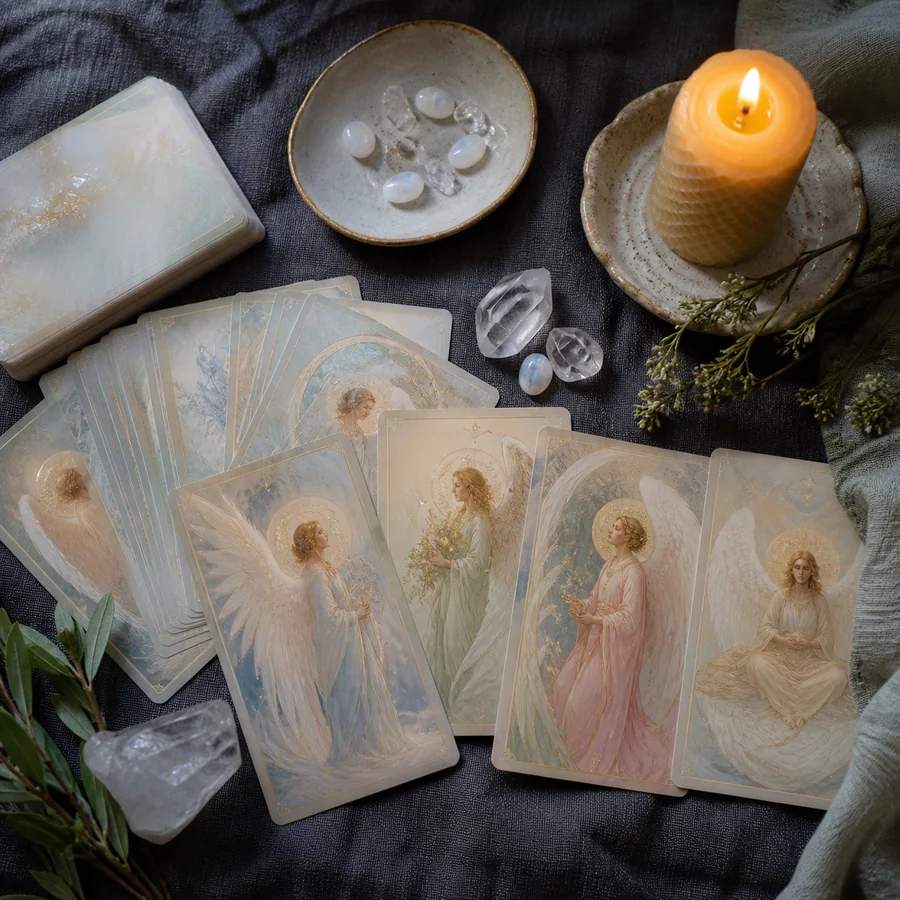
An angel card session uses a short deck of cards, each one paired with a plain-language reflection prompt, to give a hard question somewhere structured to land. This page explains how a session runs, what the cards are and aren’t, and how to get something honest out of drawing one.
This is a reflection tool, not a message from a real being and not a substitute for professional mental health care. If you’re in crisis, please contact a licensed professional or a local crisis line instead.
What an angel card actually is
Despite the name, we don’t claim the cards carry messages from angels, spirit guides, or anyone else. Each card in the deck pairs a short phrase, “a decision you’ve been avoiding,” say, or “something you already know but haven’t said out loud”, with a longer written reflection. Drawing a card is a way of letting chance hand you a starting point for that reflection, rather than staring at a blank page and trying to generate one yourself.
The name “angel card” comes from a decades-old tradition of decks marketed around angelic imagery, and we’ve kept the familiar name because it’s what most people search for. The framing we use, though, strips out the imagery-as-fact claim: a card is a prompt, full stop.
How a session runs
- You bring a question, specific is better than vague. “Should I take the promotion” gives a guide more to work with than “tell me about my career.”
- A guide draws one card, or a small spread of a few, depending on the question.
- The guide reads the prompt out loud and connects it to what you’ve shared, in plain language, not in dramatic or vague mystical phrasing.
- You talk through what does and doesn’t resonate. The most useful part of the session is often your own reaction, not the card itself.
- The session ends without a verdict. You decide what to do with what came up.
What a session is good for
- Organizing scattered thoughts about a decision you’re already circling.
- Getting a prompt to talk about something you’ve been avoiding saying out loud.
- A calmer, slower alternative to re-reading the same three text messages for the twentieth time.
What it isn’t good for
- Predicting a specific future event, we don’t claim that ability, and no deck of cards has it.
- Diagnosing or treating a mental health condition, that needs a licensed professional, not a card deck.
- Making a legal, medical, or financial decision on our word, please see a qualified professional for those.
A worked example
Say the question is “should I end this relationship.” A card comes up reading something like “a pattern you keep excusing.” A guide won’t tell you what the pattern is or what to do about it, they’ll ask what pattern comes to mind for you, specifically, right now. Often the honest answer arrives within a sentence or two of that question, because you already knew it; the card just gave the conversation a door to walk through.
The different spreads we use
- Single card, one prompt for a focused, narrow question. Fastest, and often the clearest.
- Three-card spread, often read loosely as “what’s behind this, what’s happening now, what’s worth watching next”, useful for a question with some history behind it.
- Open spread, a small handful of cards with no fixed positions, used when a question is broad (“what should I be thinking about with this transition”) rather than a single yes-or-no.
None of these formats changes what the cards are. More cards means more prompts to react to, not a more powerful or more accurate reading, pick the spread that matches how much you want to talk through, not the one that sounds most impressive.
How to prepare for a first session
- Write your question down beforehand, even roughly. A written question is usually more specific than one you improvise out loud.
- Expect to do most of the talking. A guide’s job is to prompt and listen, not to perform a monologue at you.
- Come with an open mind about the outcome, not about the framing, you can stay skeptical of “magic” and still get value from the structure.
- If your question turns out to be about a mental health crisis, a medical symptom, or a legal or financial decision, say so, a guide will redirect you to the right kind of professional instead of continuing.
Misconceptions specific to angel cards
- “The deck knows things about me.” The deck is a fixed, printed set of prompts. What feels “known” is your own situation meeting a general phrase in a way that feels specific, a well-documented effect, not evidence of a deck reading your mind.
- “Pulling the same card twice means something.” It might mean the same prompt is still useful to you, or it might just be chance in a small deck. Either reading is fine; neither is a sign, exactly.
- “A negative-sounding card is a bad omen.” We write prompts to be read as reflection cues, not warnings. A card about “a pattern you keep excusing” is an invitation to look at something, not a prediction that something bad will happen.
Frequently asked
Are the cards randomly drawn,
Yes, physically or digitally shuffled and drawn at random. We don’t claim the randomness itself is meaningful, the value is in the reflection the prompt triggers, not in the mechanics of the draw.
Can I ask about someone else,
You can ask how you feel about a situation involving someone else, but we won’t make claims about that other person’s thoughts, feelings, or intentions, we only have access to your side of it.
What if the card doesn’t resonate at all,
That’s a normal outcome, not a failure. A guide can draw again or shift to a different method, a crystal ball session or pendulum dowsing might fit the question better.